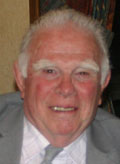
Passage of time coinciding with the demise of the Ottoman Empire and the birth of the Turkish Republic in 1923, now a vibrant State in the Middle East has fostered a different view of the Levant and Levantines about which many books have been written, amongst them, ‘A Life Apart: the fate of an outsider’. More to the point, an article published a short time ago in the Turkish edition of Marie Claire by Duygu Hamdioğlu, titled Gizli Aristokrasi (Secret Aristocracy) is about the famous Whittall Family and other notable ones who settled in Izmir.
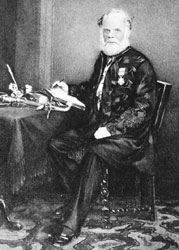
My maternal great-grandfather General Henry Selby Rickards in uniform |
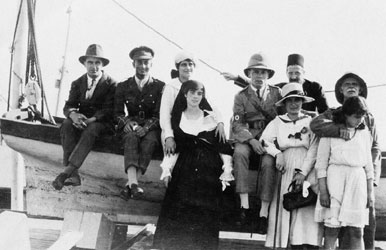
SS Carniola with family members before departure from Alexandria for Mersina July 1919. |
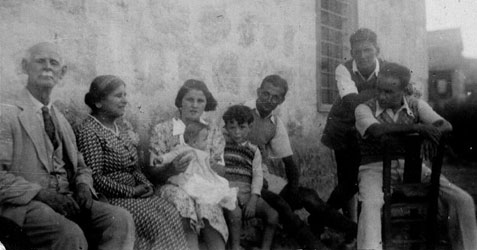
Customary daily scene outside Rickards summer house in Gözne, at sunset. 1939/40 |
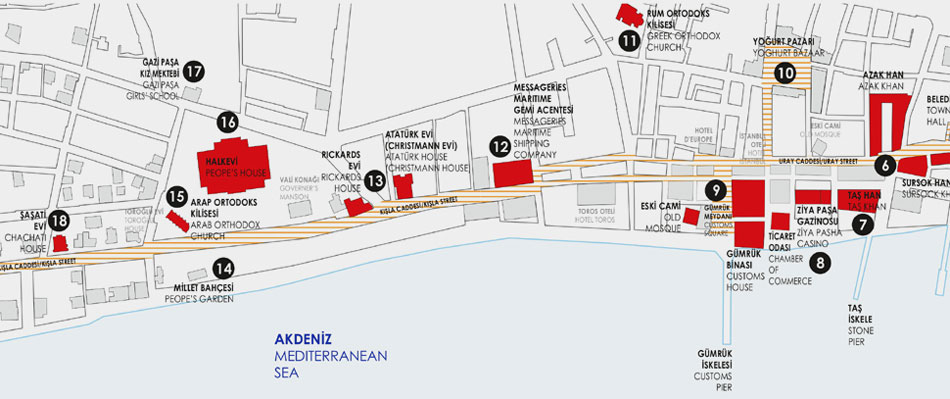
A Life Apart is not dynastic in any sense. It is not even about family but rather about a child’s struggle to overcome hardships, starting with the loss of his seafaring father who was tragically drowned at sea in the Eastern Mediterranean. His widowed mother, unable to survive in Alexandria returned to her family home in Mersina with the infant. Her English father, Henry Rickards who had come out there in 1890, married the daughter of an émigré family from Syria.
Henry Rogers Rickards, was the eldest of four. He was born on the 14th November, 1870 at Gloster Villa, Laurie Park, Sydenham which was at the time, the home of General Henry Selby Rickards and his wife Catherine. He came in 1890 to Southern Turkey and settled in the coastal town then known as Mersina. His grandson Patrick would have known little about him as he was not quite 8 years old when his grandfather passed away late in 1939. They would have known each other for only about 4 years.
Patrick’s few recollections not surprisingly are vivid, probably because his grandfather hardly ever expressed any affection for him, always referring to him rather dismissively as ‘that little shrimp’. They never spoke to each other. Occasionally when Patrick’s childish behaviour upset his mother, grandpa could be heard rather hopefully asking, “Dosia would you like me to thrash him for you.” An offer that struck terror into the infant’s heart. Until, much to his relief, his mother would decline the service proposed.
As he grew older Patrick picked up snippets of information about his grandpa listening to what his elders were saying. It was believed that it was the Railways that had brought the young Henry to that improbable corner of the world. As for his marriage to Mariam Kerroum, this was credited to the Metheny family. American evangelists who ran a small missionary school attended by Mariam who was said to be only sixteen years old at the time. Her knowledge of English I suspect would not have been of any great significance as grandpa would have arrived in Turkey already well versed in Arabic given that his own father had spent most of his working life in Egypt, in the service of the Ottoman Empire.
This shared home life in Mersina with grandparents had been difficult for Patrick but even more so for his mother who was obliged to consign him to boarding school in Istanbul from a very early age. Worse was in store, for in 1945 when the war ended Patrick just 14, was packed off to Public School in England. Narrowly escaping expulsion, he returned home to Mersin in 1949 where he was employed by Emilio Levante Succ., maritime agents. It soon became obvious to Patrick, a young man by then, that his long term career prospects were bleak. Happy though he was to be back with the people and surroundings he was eternally devoted to, he had to get away, but how!
As can sometimes happen, providence came to his rescue. Ruston & Hornsby Limited a leading engineering company in Lincoln took him on as a trainee apprentice with the prospects of eventually representing them in the Middle East. The five years in Lincoln exposed Patrick to life in work-a-day Britain of the 1950s with the country heading for egalitarianism. A very different culture from the customs and traditions that had been instilled into him at his Public School.
Deprived of a well adjusted home life in his early childhood, he went on to grapple with boarding school then the austerity of Public School in post war Britain always cut off from his widowed mother in Mersin. He had always managed to make his own decisions for the simple reason that there was no one else to guide him. It befell him in the second half of 1954 to make the hardest of decision. To leave R&H in spite of the success he had made of his five years with them and the brilliant career prospects.
The wind of change that had started to blow through Britain’s heavy engineering industries. That was what told Patrick to move on and he did. Out of work, yet true to his word, he married his soul mate Beryl Cussins on the 30th July 1955. Once more, providence was kind and Patrick was thrown a life line by the Public Schools’ appointments bureau. A management position with a small but fast growing company with prospects worldwide supplying the Foundry and Steel Industry. Foundry Services Ltd., were based in Birmingham, which with the neighbouring Coventry were boom towns thanks to the Motor Industry which was then still in its zenith. For Patrick a new start but it would still be: A Life Apart.
In the sequel to ‘A Life Apart’, I expect to dig up and examine the roots of the uniquely named Rickards family. Revealing in the process the Christian and Moslem strands that are deeply rooted in the Middle East. Mersin as it came to be called after the birth of the modern Turkish Republic in 1923 continued to be a wonderful mixture of cultures to which family descendents have returned. I will also continue the theme of my earlier days, ‘determined, knowing how to survive, and grasping the first given opportunity is the way to success’, even in a Britain that in the second half of the 1900s, sadly continued to lose its once great industries.
I am most anxious to write a sequel, I am still pondering on how best to start the story and what would be best included in the narrative spanning from 1955 upto the present. Not least of my many dilemmas is how best to deal with my enigmatic great grand farther - Henry Selby Rickards, General in the Egyptian Service but also known in the Ottoman era as Abdallah Pasha, el Ingilizi. Interestingly, the Ottoman designation ‘Pasha’ is the highest title that can be awared to both civil and military officials. According to Achievements, the Centre for Heraldic and Genealogical Research established in 1961 in Canterbury, this tribute had been bestowed on other English commanders who always used their English surnames. Two notable examples, Gordon Pasha (in the Sudan) and Glub Pasha (in the Hashemite Kingdom of Jordan). Quite by chance, the Principal of Achievements, Cecil R Humphery-Smith, I discovered when I first telephoned them in October 2000 had been my house Captain at Hurstpierpoint a lucky coincidence that led to them doing quite a bit of investigation into HSR for me, over a period of some 12 months. Professional delving far beyond my own efforts.
This was followed by my 3 day visit to Beirut in early 2003 at the instigation of Robert Fisk, the acclaimed Middle East Correspondent of the Independent. It was thanks to him that I discovered the graves of both my great grandfather and his English wife Catherine who chose to remain several years in the Lebanon after his demise.
It was also thanks to Robert Fisk that I got to know a distant cousin, descendant from Abdallah Pasha, el Ingilizi’s first marriage to an Egyptian (Moslem) wife. Noha Sadek has a doctorate (Ph.D) in Middle East and Islamic Studies from the University of Toronto in Canada. Like myself she also had an interest in finding out about HSR but being an academic, she would only give credance to facts that were officially documented. That is to say Noha Sadek had no time for ‘heresay’!
The Rickards Family Tree prepared by Achievements starts with the marriage of John Rickards to Mary Selby on the 21st May 1797 at St Marylebone, London. They had two son:
1- Prideaux Selby Rickards born 1801 Colchester, Essex. Bur. 31 Oct. 1867 Hove, Sussex.
2- Henry Selby Rickards born 1819 Colchester, Essex. Died 14 Jan. 1886, Beirut.
The additional information that has come to light since my book was published at the end of 2010 starts as follows:
Descendants of Michael RICART
First Generation
1. Michael RICART (47965) was born on 4 Apr 1733 and died in 1798 at age 65. Another name for Michael was Michael RICKARDS
My own Conclusion
I had set out quite simply to bring to life my own Grand father’s Father. That is to say Henry Selby Rickards, General in the Egyptian Service. To try and find answers to the many questions one might ask about him. What sort of a man was he. What were his achievements in life. I personally could see no point in going back further.
 |
To view the personal archive photo collection of Patrick Grigsby with his annotations, click here: and of general archive views of Mersin click here:
To view a synopsis of his book, click here:
Click here to view an advert of the business of William H. Rickards in Mersin, Patrick’s uncle (grandfather’s only son), provided courtesy of researcher Tülin Selvi Ünlü.
Note: Unfortunately Mr Grigsby passed away on the 8th June 2020. May he rest in peace.
 submission date 2011