
The Interviewees
Interview with Nicolas Nicolaides, September 2026
1- You are currently a researcher at the Centre for Asia Minor Studies, where your work focuses on Greek Orthodox scholars in Ottoman Cappadocia. Briefly would these scholars be more in the religious realm or secular and to what extent were their activities free from Ottoman government interference? Did they have their own regional newspapers and publishing houses and how much of that evidence has survived? Was there ever a tension in identity between the Greek and Karamanlica speakers / cultures and did they follow similar cultural trajectories of development as the Ottoman Empire liberalised with the Tanzimat reforms?
I am particularly grateful to the Board of the Centre for Asia Minor Studies for entrusting me, at a relatively early stage of my career, with a research position. Working with the Centre’s remarkable archival collections has allowed me to develop new questions and directions that I might otherwise not have pursued.
The scholars I study at the Centre for Asia Minor Studies occupied a space in which the religious and secular are difficult to separate in modern terms. Many were clergymen or educated within ecclesiastical institutions, but their interests extended well beyond theology to history, language, geography, philosophy, and the natural sciences.
A particularly good early example is Kyrillos VI (1769–1821), later Ecumenical Patriarch of Constantinople, who served as Metropolitan of Ikonion (Konya) from 1803 to 1810. During his tenure, he traveled extensively through his diocese, gathering geographical, historical, demographic, linguistic, and antiquarian information. The result was his remarkable Πίναξ χωρογραφικὸς τῆς μεγάλης ἀρχισατραπίας Ἰκονίου, a map published in Vienna in 1812 under the supervision of the Enlightenment scholar Anthimos Gazis, followed in 1815 by an extensive historical and geographical description of the region. His work is a good illustration of how an Orthodox prelate could simultaneously function as an educator, geographer, historian, and observer of contemporary Ottoman society.
Printing is another important part of this story. Cappadocia initially lacked the publishing infrastructure of Constantinople or Smyrna, so books were often produced in major Ottoman and European printing centers such as Constantinople, Venice, and Vienna. By the nineteenth century, however, local initiatives became increasingly important. Under Paisios II, Metropolitan of Caesarea (Kayseri), a printing press was established in the region, while books intended for Cappadocian Orthodox communities appeared in both Greek and Karamanli, Turkish written in Greek characters.
2- You were previously a Kathlyn and Peter Yatrakis fellow at the Gennadius Library of the American School of Classical Studies at Athens (2023–2024), researching the French mercantile community in late Ottoman Athens. Did your research on this topic start before this time? Your main sources of information for this research were the descriptions of Western travellers and French consular correspondence. How detailed were these latter sources and how far back did they go? Would you welcome collaboration with those who have access to Ottoman foreigner registrations (sicil) of Athens and region?
The project developed substantially during my 2023–2024 fellowship at the Gennadius Library, although my broader interest in late Ottoman Athens predates the fellowship. I am especially grateful to Kathryn and Peter Yatrakis, whose generosity in supporting the fellowship made this research possible, and to Maria Georgopoulou and Irini Solomonidi for their guidance and support. More broadly, the exceptionally collegial environment of the American School of Classical Studies at Athens greatly enriched both the project and my experience as a fellow.
The French consular correspondence proved exceptionally rich because consuls reported not only diplomatic affairs but commercial disputes, local politics, relations among merchants, debts, marriages, conflicts, and everyday interactions. Combined with travel accounts, local Greek sources, maps, and visual evidence, these documents allow us to reconstruct a surprisingly detailed picture of a community that was numerically very small.
The French consular presence in Athens dates to the seventeenth century, although the evidence becomes much richer in the eighteenth and early nineteenth centuries. Jean Giraud is a fascinating early example: after serving as French consul (1658–1663), he represented Britain (1665–1678) and, from around 1676, also assumed responsibility for the Dutch vice-consulate. His activities extended beyond diplomacy. In 1674–1675, probably at the request of the French ambassador, the Marquis de Nointel, he produced accounts of Attica and its surrounding maritime region and of the surviving antiquities of Athens. He also acted as an intermediary for Western travellers, guiding Jacob Spon and George Wheler during their visit in 1676. Giraud therefore illustrates something that became central to my research: consuls were not simply diplomatic representatives. They could simultaneously act as merchants, local intermediaries, informants, antiquarians, and guides, occupying a position between local society and wider European networks.
I would certainly welcome collaboration with scholars working systematically with Ottoman sicils and other Ottoman administrative records. One of the next important steps is precisely to bring the Western European, Greek, and Ottoman documentation into closer dialogue.
3- What were the limits in geography – you mentioned one merchant family (Cayrac brothers) based in Piraeus but were you also aware of French merchants operating in places such as Patras in Ottoman times? Dealing with time limits you dealt with late Ottoman period Athens, late 18th century till the Greek revolution of 1821. Clearly there were French consuls based in Athens and region from earlier periods (Salonica for example 1682), but were you able to trace the merchant presence from these earlier times with any certainty?
My study deliberately concentrates on Athens rather than attempting a broader history of French commerce in Ottoman Greece. Porto Leone (modern Piraeus) enters the narrative as Athens's port and a base for French merchants. When the Neapolitan traveler Saverio Scrofani visited in 1795, he encountered Joseph Cayrac, who, together with his daughter Marguerite and the monks of the monastery of St. Spyridon, was among the few inhabitants of the nearly deserted harbor. Scrofani portrayed Cayrac as living quietly among his books and devoting himself to gardening and fishing—a life resembling that “of an ancient sage” (d’un sage de l’antiquité). French merchants were, of course, active throughout the Ottoman Mediterranean, particularly in major commercial centers such as Smyrna and Salonica.
By the late eighteenth century, several French households had become integrated into Athenian society through commerce, professional service, and marriage. The Marseille brothers Joseph and André Cayrac settled at Porto Leone around 1770, operating a warehouse and inn, trading in olive oil, and holding consular office. Jean-Antoine Masson, a surgeon from Marseille, arrived in Athens in 1787 and married Maria Macri; after his death, her house became a prominent lodging place and salon for Western travelers. André Mertrud, a physician, olive-oil merchant, and antiquities dealer, settled in Athens after marrying Marguerite Cayrac in 1788. Pierre-Nicolas Roque, a merchant from Carcassonne, married Victoria-Eutychia Macri, further connecting the French community with established local families.
Chronologically, the study focuses on the eighteenth and early nineteenth centuries, when this community becomes far more visible in the sources, although a permanent French consular presence had existed since 1658. In 1676, Jacob Spon encountered only the English consul Jean Giraud, the French consul François Châtaignier, a Capuchin friar, a French gunsmith, and a few servants. Another Western resident was Johan Georg Transfeldt, a soldier who arrived in 1674, lodged with the Capuchins, assisted European scholars and antiquarians, and wrote the Examen reliquarum antiquitatum Atheniensium. The thinner seventeenth-century evidence makes individual households and commercial networks considerably harder to reconstruct.
4- Did Athens, dominated for centuries by its ruins of classical times, have any special role or significance in the Greek Enlightenment movement? Did the work of foreign consuls and antiquarians in their quest to trade and smuggle antiquities act as an impulse to heighten a sense of a deep Greek cultural heritage that needed protection and creating an independent state was one of the guarantees to stop that cultural erosion? In this quest were the motives of the Orthodox ecclesiastical aristocracy sometimes at variance to the scholars of what the nature of that Greek identity was?
Athens occupied a paradoxical position in the Greek Enlightenment. Its enormous symbolic importance as the city of classical antiquity did not initially correspond to its importance as an intellectual center: Constantinople, Smyrna, Ioannina, and Chios were more significant educational centers during much of the eighteenth century. This began to change in the early nineteenth century, particularly with the foundation of the Philomousos Hetaireia in 1813, which brought together local notables and scholars with foreign supporters around education and the protection of antiquities.
I would be cautious about drawing a direct causal line between the removal of antiquities and Greek independence. What we can see instead is a changing attitude toward ancient material culture around the turn of the nineteenth century. Elgin’s removal of the Parthenon sculptures in 1801–1805 was criticized even by contemporary Western antiquarians. The Xeneion, founded in Athens in 1811 by an international circle including Carl Haller von Hallerstein, Charles Robert Cockerell, and Otto Magnus von Stackelberg, reflected a growing emphasis on systematic study and documentation. Yet its members themselves excavated and exported the sculptures from Aphaia on Aigina and Bassai, demonstrating how fluid the boundaries between scholarship, preservation, collecting, and removal remained.
Recent work by Alexia Petsalis-Diomidis has also drawn attention to Greek encounters with antiquities through collecting, domestic display, and material culture rather than viewing them solely through the later framework of national archaeology. My evidence from pre-Revolutionary Athens points in a similar direction: antiquities increasingly appear in both consular and Athenian houses as objects to be collected, displayed, and oftentimes sold. Greek attitudes toward antiquity were therefore diverse and evolving, shaped by the intersection of Orthodox identity, Enlightenment scholarship, collecting, European intellectual networks, and emerging ideas of Greek nationhood.
5- In the painting by Edward Dodwell in ‘Views of Greece’ done in 1819, you were able to identify a person who was the son of the British Consul in Athens, Logotheti, and was this through you recognising his dress or the notes from Edward Dodwell? This person was a member of one of the 12 noble families of Athens. Did these noble families ensure power stayed within their tight circle by ploys such as only marrying from their class (+ local Levantine Catholics) and did they operate closed trade monopolies as part of their privileged position?
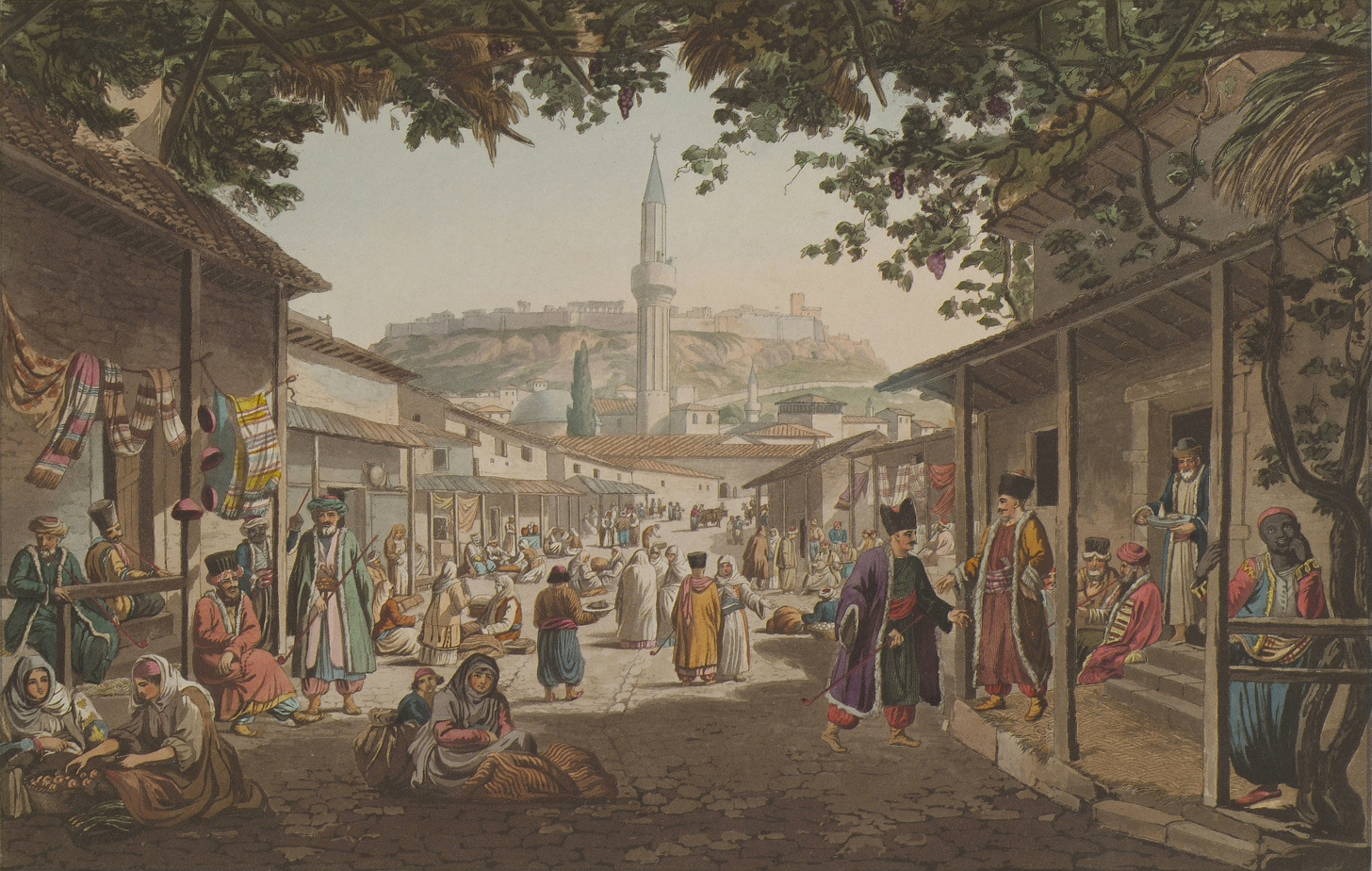
An illustration from Views in Greece, with drawings by Edward Dodwell, published London 1819.
The identification actually comes from a combination of visual and textual evidence. In Edward Dodwell’s depiction of the Athenian bazaar, published in 1821, the prominently dressed figure wearing a long anteri, a fur-lined coat, and a distinctive kalpak is identified by Dodwell as the “governor of the island of Salamis” and “the son of the late English agent Speridion [sic] Logotheti.” Alessia Zambon has convincingly identified him as Nicolo Logotheti, son of Spiridon Logotheti, who had served as British consul in Athens. His dress is therefore important evidence of status and participation in local Ottoman material culture, but it was not the basis for identifying him.
The Logotheti belonged to the small circle of prominent Athenian archontic families — that is, the city’s leading Greek Orthodox notable families — who exercised considerable social, economic, and political influence. Panagis Skouzes (1777–1847), an Athenian merchant and participant in the Greek Revolution, offers a much more critical view in his Chronicle of Enslaved Athens, written in 1841. Recalling the oppressive rule of Hacı Ali Haseki in the late eighteenth century, Skouzes portrays the archontes who collaborated with him essentially as Haseki’s henchmen, emphasizing their role as intermediaries in taxation and local government. His account is highly polemical, but it vividly illustrates how the power of the archontic elite could be perceived by other Athenians.
Marriage also helped consolidate these networks: alliances occurred both among leading Orthodox families and between them and prominent Catholic or Levantine families. Confessional boundaries therefore did not prevent the formation of dense kinship and commercial networks. I would hesitate, however, to describe the archontes as a completely closed oligarchy or to suggest that they maintained formal trade monopolies. Their influence rested instead on the interaction of family connections, property, wealth, commerce, access to Ottoman authorities, and, in cases such as the Logotheti, foreign consular office.
6- Following the sack of Constantinople in 1204 the Athens region was ruled for a time by Franks under the Duchy of Athens (1205–1456). Did the Catholic population endure post Ottoman conquest of their lands and if so, did they have a similar status as the later Catholic Levantine merchants under French protection?
There was some continuity, but we should be careful not to make it too seamless. Catholic institutions in Athens dated back to the Duchy of Athens, established after the Fourth Crusade in 1205. Under successive Burgundian, Catalan, and Florentine regimes, existing religious foundations were transferred to Latin orders—including Daphni to the Cistercians—while a Franciscan monastery was established near the Panathenaic Stadium. Latin political rule ended with the Ottoman conquest in 1456, but a small Franciscan presence survived: Giovanni Maria Angiolello recorded their monastery in 1470, although it was in ruins when the French Capuchin Robert de Dreux visited Athens in 1669.
The Catholic community that emerged more clearly in the seventeenth century, however, belonged to a different institutional world. French Capuchins established a new mission, while Catholic merchants and other residents increasingly benefited from French diplomatic protection under the Ottoman capitulations. Their legal and social position was therefore not simply inherited from the medieval Frankish community but depended increasingly on early modern diplomatic and consular networks.
This distinction is important to my use of the term “Levantine Frank”: I apply it primarily to this early modern Catholic community rather than treating it as an uninterrupted continuation of Frankish Athens.
7- You referred to the French Consul of France in Athens, Fauvel (1803-1825) as ‘notorious’ and he did indeed trade and help facilitate the export of antiquities on a vast scale. However, he played a key role in the development of archaeological knowledge of Athens and Attica by making the ‘cicerone’ (guide) to the ‘tourists’ who visited him. He was an early supporter and mentor of Kyriakos Pittakis, one of the first native Greek archaeologists and the future Ephor General of Antiquities. In addition, during the Greek War of Independence, Fauvel did save some of the surviving Turkish prisoners from the Siege of the Acropolis, several hundred of whom were massacred by irregular Greek forces in June 1822. Do you think he had some ‘redeeming features as well’ and perhaps he was one of many participating in the plunder for profit of antiquities?
I would probably avoid describing Fauvel simply as “notorious,” because he is a much more complicated figure. His involvement in the removal and export of antiquities was extensive, first in the service of Choiseul-Gouffier and later independently, but at the same time he made an enormous contribution to the documentation and study of ancient Athens. His house and collection became an intellectual center for visitors, and he possessed extraordinary knowledge of the topography and antiquities of Athens.
His relationship with Greek scholars such as Kyriakos Pittakis and his actions during the Revolution add further complexity. Rather than looking for condemnation or redemption, I think Fauvel is most useful historically as an example of a period when collecting, scholarship, diplomacy, commerce, and the removal of antiquities could coexist within the activities of the same individual. The boundaries we draw between archaeologist, antiquarian, collector, and dealer were far less clear at the time.
8- The Capuchin monastery in Athens also acted as a school, not just for the local Levantines but the Athens nobility. Clearly the acquisition of the French language through that teaching would have been key and later studies would often involve pupils studying in Venice. Could we attribute the Capuchins as a key factor in the Greek enlightenment movement though that educational facility?
The Capuchin school was certainly important because it created sustained contact between Catholic missionaries and Orthodox Athenians and provided access to Western European languages and books. Alongside the Catholic community, it attracted pupils from prominent Athenian archontic families, some of whom subsequently continued their education in Europe, particularly Venice. Kampouroglou names among its pupils Angelos Gerontas, Palaiologos Benizelos, and Ioannis Patousas, an Athenian priest and scholar active in Venice who published the Philological Encyclopedia (Ἐγκυκλοπαιδεία Φιλολογική) in 1710, a widely used Greek Orthodox educational work influenced by Jesuit pedagogical models.
The Capuchins also contributed directly to linguistic exchange. Alexis de Sommevoire, a Capuchin who spent time in Athens, published the Greek-Italian Θησαυρὸς τῆς Ρωμαϊκῆς καὶ τῆς Φραγκικῆς γλώσσας / Tesoro della lingua greca-volgare et italiana in Paris in 1709. Remarkably, almost a century later, in 1805, Adamantios Korais recommended Sommevoire’s dictionary to scholars in Constantinople working on the Κιβωτὸς τῆς Ἑλληνικῆς Γλώσσης. This gives us a tangible example of Catholic missionary scholarship entering the intellectual networks later associated with the Greek Enlightenment.
I would nevertheless hesitate to describe the Capuchins themselves as a “key factor” in the Greek Enlightenment. They formed one part of a much broader educational landscape. Their particular importance lies in their role as cultural intermediaries: they operated a school, hosted European travelers, maintained Catholic intellectual networks, and facilitated the circulation of languages, books, and ideas between Western European and Greek Orthodox contexts. My recent work on Diego de Ledesma’s Doctrina Christiana — used in the Capuchin school and later adapted within Orthodox and eventually Karamanli contexts—provides another striking example of this process.
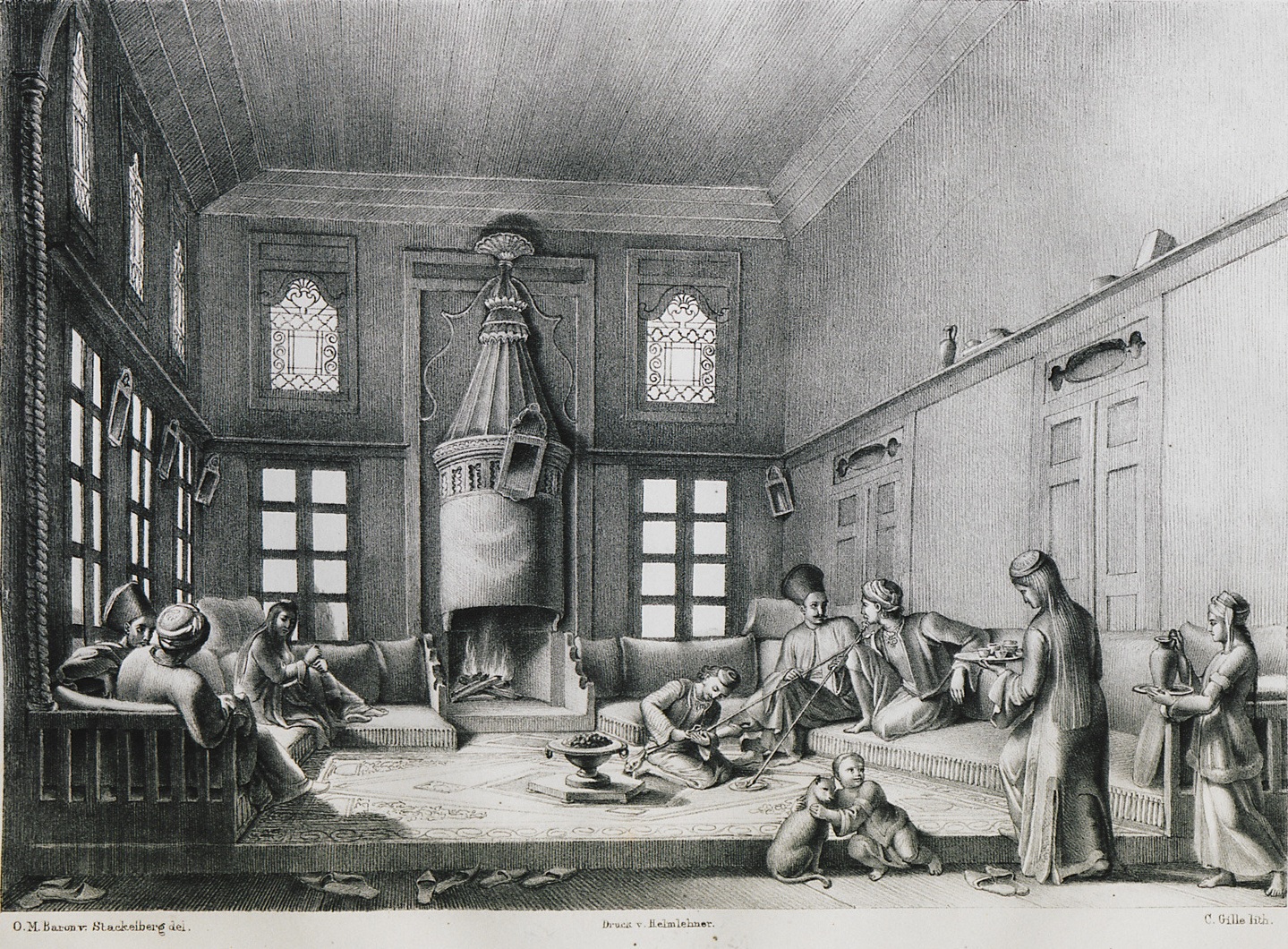
9- You were able to analyse the drawings of Otto Magnus von Stackleberg, printed in 1831, showing the layout of different Levantine houses. From the layout of the houses, would you infer these were built to order by the Levantines or were more converted earlier Greek owned dwellings in local Ottoman style then slightly altered for the French taste?
Here I would make one correction: some of the most valuable drawings of these interiors are by Carl Haller von Hallerstein rather than Otto Magnus von Stackelberg, although Stackelberg provides important visual evidence as well.
What is striking is that these houses were fundamentally part of the local architectural tradition. The Mertrud house, for example, incorporated features characteristic of Ottoman domestic architecture, including the division of domestic space and the şahnişin [a traditional enclosed balcony]. Rather than imagining French houses transplanted into Athens, I think we should see locally constructed or adapted houses in which Ottoman forms coexisted with imported furniture, tableware, paintings, books, antiquities, and other European objects. The hybrid character lies as much in the interiors and patterns of use as in the architecture itself.
10- Fauvel the French Consul came to Athens as the artist of the French ambassador Choiseul-Gouffier (term 1784-1792) and facilitated the ambassador’s collecting of antiquities in various parts of the Ottoman empire. Do you think most of these 6 French merchant families got a toehold in Athens through the services (artists / doctors) to the French diplomatic service and independent trade came later?
I would reverse the chronology slightly. Fauvel was an unusual case: he arrived in Athens as an artist and antiquarian in the service of the French ambassador, the Comte de Choiseul-Gouffier, and only later became vice-consul. The principal French mercantile families of Athens, by contrast, did not generally establish themselves through diplomatic service. Merchants such as the Cayrac brothers and Pierre-Nicolas Roque came primarily through commerce, while other Catholic families had much deeper local roots.
It is also important to keep the scale of French commerce in Athens in perspective. By the 1780s, even leading French merchant houses there, including those of the Cayrac brothers and Roque, reported annual turnovers below 200,000 livres. By comparison, the accounts of Garavaque et Cusson, one of the foremost French houses in Smyrna, record annual commercial activity approaching 500,000 livres in their strongest documented years in the 1760s. Athens was therefore a distinctly secondary market within the French commercial networks of the eastern Mediterranean. Its exports consisted largely of agricultural commodities—notably olive oil, valonia, soap, hides, and leather—and trade was particularly vulnerable to fluctuations in agricultural production.
Yet relatively modest commercial activity by Mediterranean standards could still translate into considerable wealth and status within Athens. These merchants maintained substantial households, employed servants, consumed imported European goods, and participated in the city’s social elite. Their position was strengthened further by access to French diplomatic protection and the privileges available to those holding consular offices or protected status.
Rather than seeing diplomacy as the means by which French merchants first gained a foothold in Athens, I would therefore emphasize the increasing interconnection of commerce, consular service, professional activity, kinship, and local status.
11- The head-title of your talk was ‘Orientalising Westerners’. To what extent in your judgement did the Levantine community of Ottoman Athens adopted Ottoman or Greek culture, as far as the records could display? Were you able to track and engage with any descendants of these families and if so, did that add an extra layer of clues of this hybridisation, if that is the right word?
This was one of the central arguments of the talk. Western residents did not simply reproduce French life in miniature. Over generations, many adopted aspects of local dress, domestic architecture, food, hospitality, language, and patterns of sociability. Marriage was particularly important: Catholic men frequently married local women, who appear to have played an important role as cultural mediators within these households.
At the same time, this was a process of selective adaptation rather than complete assimilation. French and Italian remained important languages, Catholic identity persisted, and connections with European diplomatic and commercial networks remained strong. “Hybridization” is therefore useful if we understand it as a fluid process in which different cultural practices could coexist within the same families and even the same households. Family archives and descendants can add another layer to this picture. Artemis Skoumpourdi, for example, published two family portraits from photographs supplied by Nikolaos Roque-Melas. They depict Pierre-Nicolas Roque, a French merchant from Carcassonne (southwest France), and his son Phocion and were probably painted by a Western European artist. Significantly, both men appear in contemporary French dress. The portraits therefore reveal another side of this hybrid identity: families deeply integrated into Ottoman Athenian society could simultaneously choose to present themselves visually as Western Europeans. This reflects a broader late eighteenth-century tendency among French residents of the Ottoman Empire to adopt à la française dress in public.
Such family material can preserve portraits, documents, objects, and traditions that have disappeared from institutional archives, although oral family memory must, of course, always be tested against contemporary evidence.
12- Were the Giraud family of Athens connected to the prominent family of the same name who settled in Smyrna (Jean Baptiste Giraud of Antibes arriving around 1780)? Were the French Levantine families in Athens trading with Ottoman ports such as Smyrna or was it strictly export of mostly olive oil to Marseilles?
I have not found evidence sufficient to establish that the Athenian Girauds were related to the prominent Giraud family of Smyrna, and I would prefer not to infer a relationship from the surname alone.
Athens’s French merchants certainly participated in networks extending well beyond Marseille. Smyrna was one of the great commercial hubs of the eastern Mediterranean, and the movement of people, goods, correspondence, and credit connected these communities. Olive oil was particularly important to Athens, but their commercial activity was not simply a bilateral Athens–Marseille export trade.
The Mertrud family provides a particularly revealing example of the reach of these networks. In 1816, André Mertrud recorded an inscribed ancient stele reused in an Athenian house. After François Pouqueville published the inscription in 1820, Lord Strangford, the British ambassador in Constantinople, acquired it the following year through his Smyrna-based agent, Luigi Canquitz. The trajectory of this single object, from an Athenian house through a French scholar and a Smyrna-based intermediary to a British diplomatic collection, illustrates the transregional networks in which Athens’s Levantine families participated.
13- When Athens became a habitable again after the turmoil of the Greek war of independence a more diverse crowd of foreigners settled in Athens, some coming in the entourage of the King Otto of Bavaria and serving the new Greek state (Alexandre de Roujoux etc.), others as Philhellenes post Byron such as the colourful George Finlay. You have conducted research on these later Westerners as well, and is there more research to be done in this arena and would you be open to pursuing that?
Absolutely. The establishment of the Greek kingdom transformed rather than ended Athens’s role as a meeting place for foreigners. The small Levantine community of the Ottoman period was joined or replaced by a much more diverse population: Bavarian officials and other Europeans who came with King Otto and entered the service of the new state, diplomats and archaeologists, and an older generation of Philhellenes such as the Scottish historian George Finlay (1799–1875), who settled permanently in Athens.
What particularly interests me is the transition between these two worlds. Cesare Vitali’s diaries, covering the period from the outbreak of the Revolution in 1821 to the surrender of the Acropolis in 1827 and recently published by Francesco Scalora, offer a rare first-hand account of precisely this moment of upheaval.
There were also important continuities. Antiquities that had circulated through private households and commercial networks before the Revolution were now increasingly redirected toward the institutions of the new state. Alexia Petsalis-Diomidis has highlighted the case of Nikolaos Phlogaïtis (1799–1867), a revolutionary and jurist who donated his collection of sixty vases to the state archaeological museum established on Aegina under Ioannis Kapodistrias. By contrast, Bartholomée Mertrud, son of the French physician and merchant André Mertrud, sold more than one hundred vases to the same institution in 1831. These different forms of transfer—donation and sale—illustrate how older practices of private collecting and commerce coexisted with the emerging idea of antiquities as national patrimony.
There is therefore a great deal more to investigate, particularly the continuities and ruptures between Ottoman and early national Athens. I would certainly be interested in pursuing this transition further, although my current research remains primarily focused on the Ottoman period.
14- You picked up a huge amount of detail recorded both in word and pictures by foreign travellers such as the Ottoman style internal layout of the Mertrud house as shown on an engraving by Haller von Hallerstein (1810-17 Athens residency). Do you think there might be more engravings of early Athens to access, perhaps in the holds of distant libraries or not published but retained by descendants, which could further illuminate these past settings and cultural milieu? Do you think many historians do not put enough emphasis in the clues within that visual record?
Very much so. One of the strongest lessons from this research has been how much information survives in visual sources that was never recorded in writing. Drawings can reveal furniture, clothing, the arrangement of rooms, architectural features, antiquities embedded in walls or displayed as collections, and even patterns of sociability.
I am certain that more material remains unidentified in sketchbooks, archives, libraries, and private collections. Hallerstein is an excellent example: drawings that at first appear to be picturesque records can become important historical evidence once individual houses, objects, and people are identified. Historians have traditionally privileged textual evidence, whereas I think visual sources should be interrogated with the same seriousness—while also recognizing that they are constructed representations rather than photographs of reality.
15- The Benizelos mansion was recently restored but taken back to Ottoman times rather than the later neo-classical period, using the drawings of Otto Magnus von Stackelberg. But the house had an even earlier history going back to the 16th century. Do you think the restorers picked the right time-period for that reconstruction and do you think they did a good job? Could the still standing but ruinous Metruk house also benefit from a similar restoration, or do you think the building is too far gone in its decay?
I think the restoration of the Benizelos mansion has been enormously valuable. The choice to reveal its mid-eighteenth-century Ottoman phase was, in my view, the most meaningful one. The earlier structure had already been incorporated into the eighteenth-century konak, which reused substantial parts of its masonry, while later neoclassical additions had significantly altered the character of the building. Restoration is inevitably selective, but Athens retains numerous examples of neoclassical architecture and remarkably few Ottoman houses. The nearby Gaspari house, for example, was restored in the late twentieth century with its neoclassical phase preserved. The Benizelos mansion therefore offers something much rarer: an opportunity to understand the scale, spatial organization, and material character of an elite Athenian house under Ottoman rule.
The Mertrud house presents a very different case. The large mansion depicted by Carl Haller von Hallerstein and Otto Magnus von Stackelberg no longer survives; it was destroyed during or after the Greek Revolution. Its extensive plot was subsequently divided and built over, and today contains an early post-independence neoclassical house, now itself in a ruinous condition, as well as later twentieth-century buildings. Archaeological investigation of the plots and their courtyards might reveal foundations or other traces of the Mertrud mansion, but there is simply not enough surviving fabric to contemplate a reconstruction. What would be extremely valuable, however, is an archaeological investigation that could relate any surviving remains to Hallerstein’s remarkably detailed plans and drawings of the house.
16- The various archaeological travellers to Athens established the Xeneion Society. Was this society a way of facilitating the information and networks to trade and smuggle antiquities? Was the later Athenian Philamuse Society instigated in opposition to the earlier society with the aim of protecting antiquities and establishing a museum for these? Was it successful in this endeavour?
The Xeneion was founded by foreign artists, architects, and antiquarians who shared an enthusiasm for Greek antiquity, but I would hesitate to characterize it primarily as an organization for smuggling antiquities. Its members certainly participated in excavations, collecting, and the removal of antiquities—notably at Aigina and Bassai—but it was also an intellectual and social network.
The Philomousos Hetaireia, founded in Athens in 1813, had a different constituency and purpose. It brought together Athenians and foreign supporters around education, scholarship, and the preservation of antiquities. Protection of antiquities and the creation of a museum formed part of its ambitions, but I would not describe it simply as a reaction against the Xeneion. Both societies emerged from the rapidly expanding European and Greek engagement with the material remains of antiquity, but they approached that heritage from different institutional and cultural positions.
17- The Levantine Franks through their accumulated wealth became money lenders to Athenian merchants, sometimes with drastic consequences for those who couldn’t later pay back the loan. Clearly this would lead to hostility amongst the merchant class but do you think this re-enforced a sense of unfair privilege and a degree of monopolisation of the olive oil trade? Did this usury extend to members of the local Ottoman officials or the local Greek aristocracy?
Moneylending is one of the areas where the sources reveal genuine tension. French merchants possessed access to capital and international commercial networks that could place them in a strong position relative to local borrowers. When debts could not be repaid, consular and diplomatic intervention could transform what began as a commercial dispute into a political confrontation.
I would nevertheless distinguish this from proving a monopoly of the olive-oil trade. French merchants were important participants, but local Orthodox merchants and Ottoman actors remained involved in production, finance, and commerce. Credit relationships also crossed communal boundaries. Members of the Orthodox elite, merchants, officials, and foreign residents could all become lenders, borrowers, partners, or intermediaries. What is particularly revealing is how economic power interacted with foreign protection and consular privilege.
18- You have an interest in food history. The first Greek-language cookbook, a translation from an Italian one was published in 1827 in the cosmopolitan island of Syros. Have you had a chance to study this and would you consider the foundation of modern Greek cuisine derives heavily from the mixture of influences that the Cycladic islands represented?
Food history is an interest of mine, although it is not currently my principal research field. The nineteenth-century Greek cookbook tradition is fascinating precisely because it demonstrates how difficult it is to identify a single origin for “modern Greek cuisine”. Italian, Ottoman, Balkan, eastern Mediterranean, and eventually French culinary influences interacted with highly diverse regional traditions.
Syros is particularly interesting because Ermoupolis (capital of the South Aegean region) emerged after the Greek Revolution as an exceptionally cosmopolitan commercial center. The early Greek cookbook published there contained around one hundred recipes drawing on Venetian and Genoese traditions as well as French, German, English, Spanish, and Dutch cooking. One particularly fascinating recipe is an early relative of what we would now recognize as pastitsio. It does not use that name, however, but calls the dish artokreas (ἀρτόκρεας, literally “meat-bread”): macaroni, spiced meat, and even prunes were enclosed and baked within a pastry crust. The resemblance to later pastitsio is recognizable, but so too are the differences.
I would therefore hesitate to describe Syros or the Cyclades as the birthplace of modern Greek cuisine. Rather, Syros provides an unusually vivid example of the circulation, adaptation, and gradual localization of recipes through which a modern Greek culinary repertoire eventually emerged.
19- The Greek nation right from its inception has looked at its classical past as its ‘golden age’ and it could be argued there was a deliberate policy of shaping that sense of identity and perhaps creating a false impression that ancient Athens was the only Hellenistic city of significance? When Athens became a capital in 1830s dozens of medieval churches dating back to the Byzantine or medieval period of Greek history were torn down to make way for wide, straight streets that gave a view of the Acropolis, crowned by its ancient temples. In the 1930s the whole quarter of Vrysaki at the foot of the Acropolis was levelled so archaeological excavations could reveal the remains of the ancient Agora. However in 2007 the proposed demolition of 2 listed historic buildings blocking the view from the New Acropolis Museum restaurant was not enacted following protests. Do you think there is now a more holistic appreciation of the layers of history and culture on which Athens rests?
I do think attitudes have changed considerably. Nineteenth- and much twentieth-century Athens often privileged classical antiquity at the expense of later historical layers. Byzantine, Frankish, Ottoman, and even relatively recent buildings could be regarded as obstructions separating the modern city from an idealized classical landscape. The clearance of the Agora is perhaps the most dramatic example because an entire modern neighborhood was removed to expose the ancient site.
At the same time, I would avoid describing this simply as the creation of a “false” history. Classical Athens genuinely possesses extraordinary historical importance. The issue is one of selectivity: which past is preserved, displayed, and incorporated into collective identity, and which past is rendered invisible.
There is now much greater recognition that Athens is a palimpsest. The restoration and presentation of Ottoman-period buildings such as the so-called “Bathhouse of the Winds”, the Fethiye Mosque in the Roman Agora, and the Benizelos mansion, as well as the recent reopening of the Tzistarakis (Dizdâr Ağa) Mosque as part of the Museum of Modern Greek Culture, reflect a growing interest in the city’s medieval and Ottoman past. Together with continuing debates surrounding modern architectural heritage, these developments suggest a more layered understanding of the city. That does not mean that conflicts over heritage have disappeared; rather, the criteria by which different historical layers are valued have broadened.
20- You moved from Istanbul to Athens as a child. Do you think that cultural translocation early in your life has given you a distinctive perspective in considering the interchange of cultures in both cities through their history?
Inevitably, I try to distinguish personal perspective from historical argument. Having experienced both Istanbul and Athens has probably made me particularly sensitive to cities as places where languages, religions, communities, and cultural practices overlap rather than fitting neatly within later national categories.
Both cities have also undergone powerful processes of remembering and forgetting. Their modern identities were constructed partly by emphasizing particular historical periods while diminishing others. That may explain some of my attraction to communities that sit between conventional categories, Levantines, Ottoman Orthodox intellectuals, multilingual communities, and people whose identities do not map comfortably onto the national boundaries that later became dominant. For me, studying those intersections is one way of recovering some of the complexity that modern narratives can sometimes obscure.
Interview conducted by Craig Encer
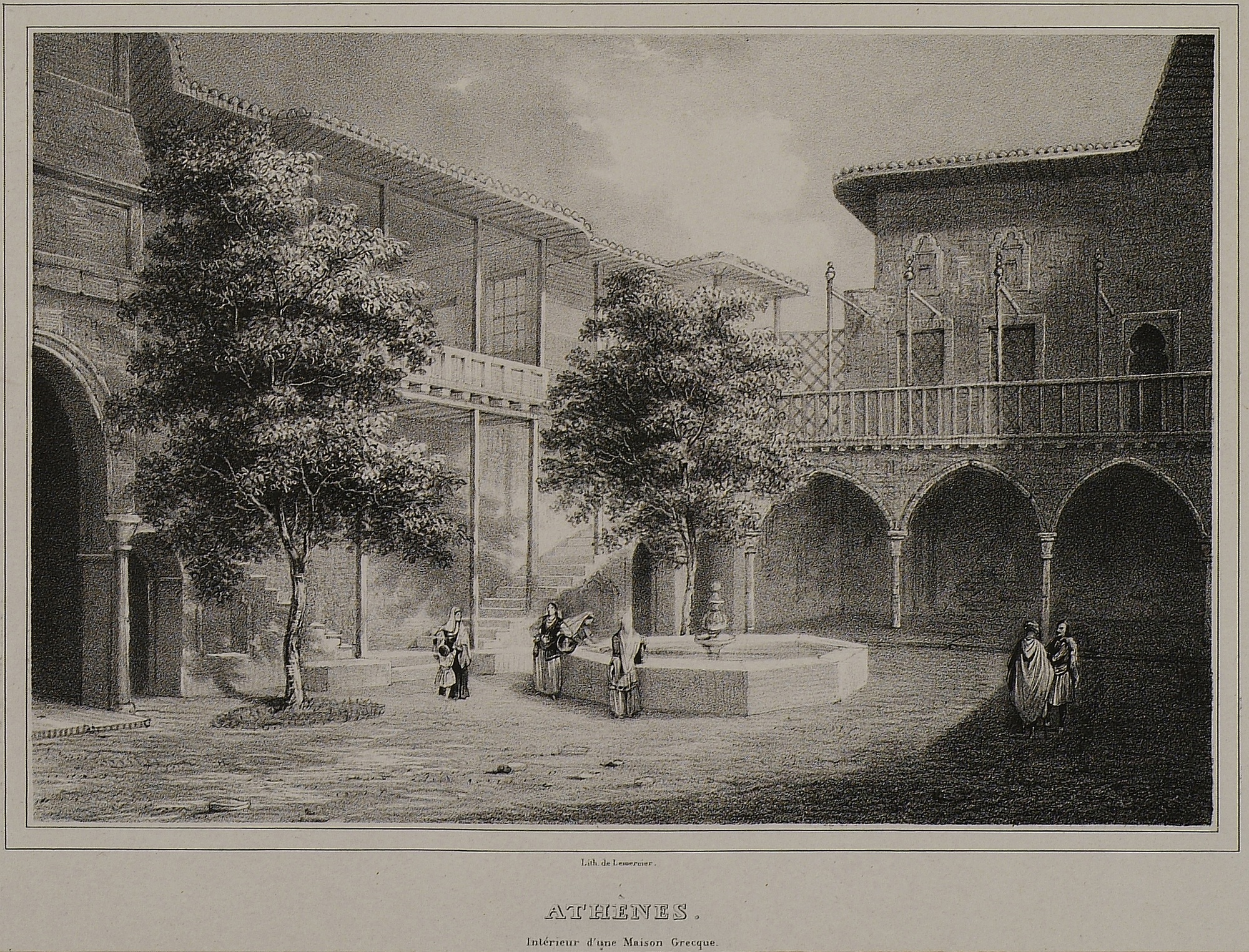
The interior court of the Mertrud house in Athens.
O. M. von Stackelberg, La Grèce: Vues pittoresques et topographiques (Paris, 1854) - image source: