 |
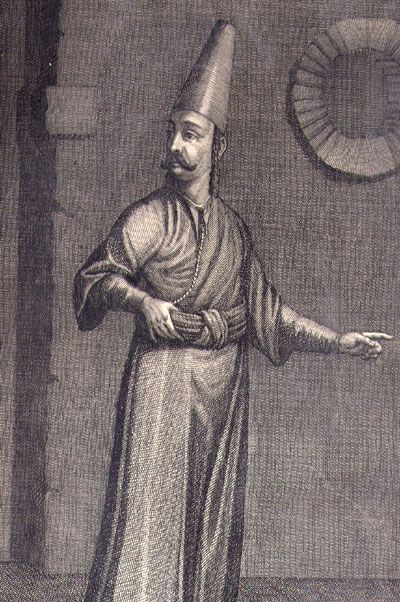
Displayed in frames in Edward’s flat, ripped out of a book by others long
ago. The New York Public Library digital gallery gives detail of this
engraving here,
and the name Baltadji here doesn’t refer to the similarly written Italian
Levantine family that still lives in Turkey, but a Turkish military guard
official, Baltacı, whose function was ‘trainee guard of improsed
princes’. The roll-over is another engraving forming the set with a palace
theme, with the title of ‘Ich oglan - Page destine pour le service du
Grand Seigneur dans le Serrail’.
According to an auction web
site, the following information is gleaned from the book from which
these prints came from originally. Publisher: [LE HAY] FERRIOL, Charles
de, title: Recueil de cent estampes representant differentes nations du
Levant., published in: Paris. Chez le Hay & Duchange Collambat. 1714
& 1715.
The 100 engraved plates are beautifully coloured and heightened with gold. The colouring is recently added but in the style of the time. Charles de Ferriol, who was the French Ambassador to the Sublime Porte from 1699 to 1709, commissioned the plates for this work. They are of particular interest since they cover both the Turkish Court, the military &c., as well as the various costumes of the peoples of the Empire: the Greeks, Armenians, Wallachians, Persians and so on. The images themselves were engraved after drawings by the Flemish artist Van Mour, an inhabitant of Constantinople at the beginning of the eighteenth century. Recueil de cent estampes is an elaborate costume book comprised of numerous plates depicting the exotic dress of Turkish courtiers, individuals from the different classes of Turkish society, and natives of the various countries that were part of the Ottoman Empire or “Levant” as it was known during this period. These beautifully rendered images were engraved after drawings by the Dutch artist Jean-Baptiste Van Mour (1671-1737), who accompanied de Ferriol to Istanbul in 1699, where he avidly sketched views of the bustling city and its inhabitants and gained privileged access to the court of Ahmed III (1703-1730). Van Mour remained in Istanbul for 37 years and was later appointed Peintre ordinaire du Roi en Levant in 1725.
The 100 engraved plates are beautifully coloured and heightened with gold. The colouring is recently added but in the style of the time. Charles de Ferriol, who was the French Ambassador to the Sublime Porte from 1699 to 1709, commissioned the plates for this work. They are of particular interest since they cover both the Turkish Court, the military &c., as well as the various costumes of the peoples of the Empire: the Greeks, Armenians, Wallachians, Persians and so on. The images themselves were engraved after drawings by the Flemish artist Van Mour, an inhabitant of Constantinople at the beginning of the eighteenth century. Recueil de cent estampes is an elaborate costume book comprised of numerous plates depicting the exotic dress of Turkish courtiers, individuals from the different classes of Turkish society, and natives of the various countries that were part of the Ottoman Empire or “Levant” as it was known during this period. These beautifully rendered images were engraved after drawings by the Dutch artist Jean-Baptiste Van Mour (1671-1737), who accompanied de Ferriol to Istanbul in 1699, where he avidly sketched views of the bustling city and its inhabitants and gained privileged access to the court of Ahmed III (1703-1730). Van Mour remained in Istanbul for 37 years and was later appointed Peintre ordinaire du Roi en Levant in 1725.